Monday, December 31, 2012

Modern Abolitionists

Modern day slavery has been a topic of discussion for a while, and we have previously talked about underpaid workers in foreign factories. However, this article in the New York Times also brings up the issue of human trafficking. While it is worse in other countries, human trafficking often takes place in the United States. Thousands of people in the United States are held against their will and are victims of exploitation. They are forced to work endless hours for no pay. As Obama has declared, human trafficking is modern day slavery.

What I find most interesting about the article is how it was closed. It ends with, "For those who insist they would have been abolitionists during the Civil War, now is the chance to become one." I find this especially interesting, because so many people learn about slavery, and do not doubt that if they had lived during that time, they would have done everything they could to help free the slaves. I admit to having thought that about myself at times. It is so easy to recognize the wrongs of slavery now, and say that you would have done something. But in reality, there is a form of slavery going on in our own country right now, and very few people have been doing anything to stop it.

I believe that there needs to be more awareness of human trafficking in the United States for anything to be done. How can we bring awareness? Do you think that people who claimed they would have done something during the Civil War will do anything to help stop modern day slavery?

Monday, December 17, 2012

Tragedy Strikes: Cause for Change

On Friday, a tragic shooting of 26 innocent victims happened in an elementary school in Newton Connecticut. Americans all over the country are grieving for the victims and are sending out their support and keeping everyone affected in their thoughts. For the most part, we as Americans are coming together to grieve for the victims. Memorials and tributes are everywhere, and the list of the victims was published to keep their memory alive.

However, the tragedy also brings up the controversy of gun regulation, an ongoing battle for many Americans. I personally believe that something needs to be done about our gun control policies in order to better prevent these mass shootings from continuing to happen so frequently. I know that having stricter gun regulations will definitely not completely stop the violence, but anything that may help us get a little closer to limiting the amount of gun violence in America I believe is a success.

Many people also believe that now is not the time to be arguing about gun polices because we should only be remembering the victims. While I agree that it is of utmost importance to remember the victims and send our support, I think that now is the time to act on gun regulations. Right now is when Americans are outraged, right now is when we have enough motivation to make something happen. In a few months, probably even sooner, the Sandy Hooke tragedy will just be a distant memory for many Americans. Most people, besides those directly affected, will go back to their daily lives, and not think about the tragedy anymore. However, events like this keep happening, so I think that in order to prevent future tragedies, we need to discuss these issues now.

Do you agree that now is the time to discuss gun regulations? What are your opinions on gun regulation?

Sunday, December 2, 2012

The Civil War: The War of Northern Aggression?

Last week, someone mentioned that in the south, the Civil War was always taught as The War of Northern Aggression. I have never heard the Civil War referred to as that in my entire life, so it really got me interested in how the same subject could be taught so differently depending on your geographic location. The material that kids learn are so biased based on what their teachers chose to teach them and their teachers' biases come from what they learned in school. So the education system is a cycle of biases. I think that it is really strange that a student in the south could be learning completely different things from a student in the north. I think that there needs to be a way for the gap in the education system to be bridged.

It was mentioned in class that the Civil War wasn't about slavery, but was about "the north trying to destroy the south's economy." While I respect that person's opinion, I believe that the main reason for the war was about slavery. There were obviously other factors, but the central conflict of the war, based off of my previous knowledge, was slavery. A professor at Clemson University wrote here about her experience of hearing about the War of Northern Aggression from some of her students. She asked her students to think about the rhetoric of the terminology, "about why a specific region calls it something that inherently blames the entire rest of the country for the war and its devastating repercussions to the South." I think the terminology in itself teaches students in the south that the south was the innocent side in the war. The north came in to ruin the south and take away their rights. I probably also have a pretty biased view of the war, in thinking that the north was a reluctant hero of sorts, just trying to free the slaves and keep the country united. However, I am trying to gain a less biased view of everything that I learn, so I am trying to be open to every side of history.

How do you think our education system is impacted by bias? Is there a way to eliminate it? Also, what do you think about the Civil War being referred to as The war of Northern Aggression?

Sunday, November 25, 2012

Petitions for Secession

After Obama won the election earlier this month, many petitions have gone up onto the We the People website. Anyone can post a petition on the We the People website, and if a petition gets more than 25,000 signatures, it must be reviewed by the White House. All 50 states have a petition to secede, but the Texas petition has the most signatures. Currently there are 117,108 signatures on Texas's petition. While these petitions aren't from the states themselves, it is alarming that a petition to secede from the Untied States can get so many signatures. I think that many of the signatures may just be the initial reaction of people upset by the results of the election, but at the same time, many of the signatures are also from people seriously wanting to withdraw from the United States and create their own government.

There are also petitions in response to the secession petitions on the We the People website. One petitions says to, "Deport Everyone That Signed A Petition To Withdraw Their State From The United States Of America." If people really were deported for signing that petition, that would be a clear violation of the first amendment. Even so, that petition has 25,375 signatures.

Both the secession petitions and the one wanting to deport the people who signed them are both very extreme, so the number of signatures that both of those petitions received is an alarming wake up call of how upset people are with the current state of the government. The fact that even a small percentage of americans would be comfortable with splitting up the United States, or others would be willing to so blatantly ignore the first amendment, even if we are in perilous times, is unnerving.

Why do you think people signed either of these petitions? And how do you think the White House could best respond to these petitions?

Sunday, November 11, 2012

Traumatized Veterans

Today being Veterans day, and reading Mr. Bolos's blog post this morning inspired me to think about how veterans are treated in America. On the NY Times website, I found an opinion piece called "When War Comes Home" about a decorated combat veteran, Staff Sgt. Dwight L. Smith Jr., who ended up murdering a 65 year old woman. The author, Nicholas Kristof, tries to explore whether soldiers' brain injuries and traumas from war could be blamed for crimes committed later. Staff Sgt. Dwight L. Smith Jr. was diagnosed with PTSD (post-traumatic stress disorder) after being blown 15 feet in the air by a mortar shell.

Kristof brings up the question whether the army could have done a better job in screening Sargent Smith's mental health. I think they definitely could have. Asking questions of the soldiers is simply not enough. There needs to be a more intensive screening process of soldiers coming back for war, so that they can attempt to treat whatever problems may be present. Smith wrote a letter to his father in which he wrote, "I am going to be honest with you dad. I have killed a lot of men and children. Some that didn’t even do anything for me to kill them.... I think I got addicted to killing people." If Sargent Smith was able to admit to his father that he had this problem, a professional should have been able to at least see that Smith had some serious problems that needed to be dealt with before he was integrated back into society. He needed to be meeting with psychologists and doctors in order to cope with his PTSD.


Do you think the Army is partly responsible for what Sargent Smith did? How do you think America can better deal with Veterans with serious brain injuries and trauma?

Sunday, November 4, 2012

American Atrocities

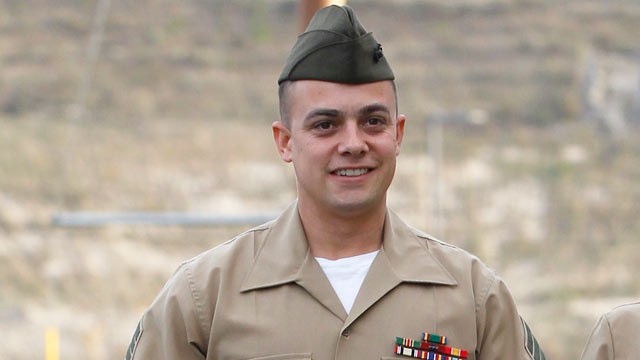
In class on Friday, we talked about how american soldiers are often viewed by other Americans as the "good" soldiers, who play by the rules and only fight for what is right. However, in reality, American Soldiers are responsible for many atrocities during war time. The Vietnam War group talked about the massacre of civilians in Vietnam by American Soldiers, but that was not the only Atrocity committed by American Soldiers. In 2005, a group of US marines killed twenty-four unarmed Iraqis, many of whom were women and children. Staff Sgt. Frank Wuterich admitted to telling his men to "shoot first and ask questions later."
Staff Sgt. Frank Wuterich


In this CBS News article, they reported that Wuterich and his men were all found not guilty in January 2012. Their manslaughter charges were all dropped. I thought it was very interesting that a man who admittedly murdered unarmed civilians was let go completely free. It seems to go against everything America stands for. Why should we hold a double standard? If we had found out that Iraqi soldiers had massacred 24 American civilians, there would be mass outrage. Do we value American lives over all others? Why do Americans have this idea that American Soldiers can do no wrong?

Sunday, October 21, 2012

Romneyspeak

In class, we've talked a lot about the presidential candidates trying to relate to the general americans. Generally, politicians try to speak in a way, that will attract the demographics that they think are likely to vote for them. This New York Times article, points out Romney's distinctive language. Romney uses what the author of this article calls "Romneyspeak." "In Romneyspeak, passengers do not get off airplanes, they “disembark.” People do not laugh, they “guffaw.” Criminals do not go to jail, they land in the “big house.” Insults are not hurled, “brickbats” are." Romney uses very polite formal language, and the author of this article suggests that his language sets him apart from many Americans.

I agree with the author that his language definitely keeps him removed from many Americans. He already is not very relatable to many Americans because of his extreme wealth and power, and I think his language sets him apart even more. Its almost as if he's set himself upon a pedestal. It almost seems like he thinks he is too good to speak like average Americans speak.

What do you think? Do you think Mitt Romney's language is a disadvantage to his campaign?

Sunday, October 14, 2012

New Food Labels for Healthier Choices

In class and on the anamericanstudies blog, a lot of people have been discussing the best possible way to get people to eat healthier. Today I came across this New York Times article on improving food labels. Mark Bittman suggests that, "a red, yellow or green “traffic light,” for example — would encourage consumers to make healthier choices." He thinks that if you have three categories (Nutrition, Foodness, and Welfare) rated out of 5 each for a total of 15 points, consumers would be able to easily tell the quality of their food. It would obviously include how nutritious the food is, but it would also take into account how natural the food is, and how the animals and workers are treated in production.

While I don't think this is possible at this point in time because the food companies would object, I do think that this would be very beneficial to the health of Americans. The current food labels can sometimes be confusing and misleading, so if you are not well informed, it is difficult to make the right food decisions. With this new labeling process, any consumer would be able to make healthy choices.

Do you think that this new food labeling system could help the overall health of Americans? And how do you think we could get the food producers to adopt this system?


Monday, October 8, 2012

Universities and Their Surroundings

This weekend, my mom and I went on a college road trip of sorts up the east coast. We visited many colleges with beautiful campuses. What really struck me though was the contrast of many of these universities between the campus and the neighborhoods that border the campuses. We saw this a little bit during our field trip to Hyde Park between the University of Chicago and the surrounding neighborhoods. However, this contrast is visible in many other locations. The contrast of Yale's campus and surrounding New Haven, Connecticut really stuck out at me. When we were driving towards the campus, we saw rows of small partially dilapidated buildings with bars on all of the windows and doors. But suddenly after crossing an intersection, the next block is filled with expensive stores like J Crew and the Apple Store. The contrast was really shocking. Literally  one street divided a population surrounded by poverty from extremely wealthy population of educated young adults.

Yale's College Town
Many other universities had similar contrasts. It was interesting how many of the universities talked about community service opportunities for students to help out the communities they were in such close proximity to. It was nice to know that the universities are working towards integrating the neighborhoods with the university, but it didn't seem like much visible progress was being made. Do you think it's important to integrate wealthy Universities to their surrounding neighborhoods? How do you think this could best be achieved?


Sunday, September 30, 2012

Teacher Bias

On Friday during class, we discussed whether teachers should let their students know their political views. Many teachers debate whether they should be upfront with their beliefs, or they should keep them to themselves in order to be unbiased. I think in many classes, it is simply unnecessary for teachers to let their students know their political views. I cannot think of any benefits of a math teacher or a foreign language teacher to share their views. I think them sharing their views could potentially sway a student to believe what they believe because kids are very impressionable.

However, when it comes to Social Studies teachers especially, it becomes unclear if it is best to share political views. Because many of the topics in class will cover politics, I think students should know the teachers biases beforehand so that they understand what they are learning may come with a slight bias. Even if the teacher tries to remain neutral, it is very difficult to not have a bias when discussing politics. 


It is hard to determine the difference of enforcing views on students and just letting them know what they believe. Samuel Issacharoff, a professor of law at New York University, said here, "The line we seek to draw is that individuals who are public employees retain the rights of full citizenship in society and do not lose them as a result of being state employees. On the other hand, they can’t use their state employment to accentuate the power of their political views. That’s the tension."


So in what circumstances do you think it is appropriate for a teacher to let their students know their political views?

Sunday, September 23, 2012

Blank Stares from our Favorite Celebrities

Last week I had the chance to visit the Museum of Contemporary Photography at Columbia College with our American Studies class. As I looked at the exhibits, one struck out at me as especially interesting. Harry Shearer's exhibition called "The Silent Echo Chamber" featured videos of celebrities before a taping. These recordings were never broadcasted, but Shearer managed to pick up the signals of unaired television but he chose not to reveal exactly how he came upon these videos.

Televisions are hung on the wall on the top of the staircase for viewing. On each television, one celebrity is shown siting in silence. Some nervously tick, some practice their smiles, but most give a completely blank stare. In this PBS article about his exhibition, Shearer claims that he wants to leave his art up to be interpretated by the viewers. He says, "I'm trying to give people as little surrounding content as possible, as little interpretation as possible." He wants everybody to "make up their own story."

To me this exhibition shows that nothing that we see on TV is completely real. As much as we think we may know our favorite celebrity inside in out, in reality what we see is only what they choose to show us. They create their own carefully manufactured personality in order to achieve the goal they want to show. We're lead to believe that these people are the smiling faces we see on camera all the time, but most of the time they are no different than any of us.

As the artist leaves this exhibition up for interpretation, there are definitely many different ways to view this exhibition. How would you interpret this exhibition?

Monday, September 17, 2012

Teacher Evaluations in Chicago

I have been constantly reading in the news and hearing about the Chicago teacher strike over the last two weeks. The strike has goals to have higher teacher raises for the extended school hours but the main focus of the strike has been about teacher evaluations. The Mayer of Chicago, Rahm Emanuel, wants to implement a rigorous evaluation system of the teachers partly based on student test scores. Many of the teachers believe this is an unfair way of being evaluated because student performance is linked to conditions in a students home and neighborhood so it would be unfair to punish the teachers for this. In this New York Times editorial, the author argues that test scores are an important part in evaluating teachers because most teacher evaluations are based on principals visiting classrooms who "declare nearly every teacher good, or at least competent, even in failing schools where very few if any children meet basic educational standards."

While I agree that the evaluation system definitely needs to be revamped, I don't agree that test scores should be everything. An objective evaluator should be sent to each classroom to really judge the teachers and how they interact with their students. It is impossible to measure on a standardized test how a teacher can inspire their students to enjoy learning, and in my opinion that should be the single most important job of any teacher. A teacher might do this by starting with subjects that interest the students in order to engage them, and that material might not be taught on a standardized test. On the contrary, a teacher who strictly teaches to a test may produce better student test scores, but the students may learn to resent learning which does not bode well for their future.

The teachers who argue that test scores are not fair because the conditions of where the students live is linked to their performance are probably in one of two groups. They are either teachers that fail to teach their students well, or teachers that inspire their students to enjoy learning, but weren't yet able to make a drastic difference in their test scores. Testing based evaluations, even if they take into account the students conditions, are not even able to separate the greatest teachers from the worst teachers. I really believe that a much stricter evaluation system should be implemented, however only a very small percentage of the teacher evaluation should be based on student test scores. Somehow, we have to create more classroom sit ins by unbiased officials. This way they can get a feel of the classroom environment and only keep the best teachers.

How do you think is the best way to evaluate our teachers?

Sunday, September 9, 2012

The Impact of First Ladies

I along with many other Americans, was very moved by Michelle Obama's speech. She managed to inspire the country while still sounding like just another mom. This led me to reflect upon the importance of the First Lady. Many Americans value the First Lady and the rest of the President's family. They shin a light on the President's personality and show who he really is outside of his political speeches in front of thousands of people. It is good to know that the President is loved by those closest to them and the person you are voting for really is a good person at heart. Also, many American's really like the idea of a "family man" who loves his wife and children first and foremost because many americans can easily relate to this. Seeing the President as a family man allows them to see themselves in the President, which really can influence a vote, because people are drawn to people that are similar to them.

The First Lady can also have great impacts of their own. During Obama's last four years as President, Michelle Obama has advocation on the behalf of military veterans, planted an organic garden at the white house, and most notably started an initiative called "Let's Move" to try to solve childhood obesity within the next generation. You can read more about that at the Let's Move website here. It's goals are to give "parents helpful information" and foster "environments that support healthy choices." She has done a lot of work for this initiative, even having Beyonce write a song called Move your Body to help get kids moving. Other First Ladies have had major impacts during their husbands' terms and even after. Eleanor Roosevelt, Jacqueline Kennedy, Betty Ford, and Hillary Clinton all majorly impacted America as First Ladies.

Thinking about the impact of the First Ladies, led me to wonder if it would be possible for a single man or woman to become president in this day and age. The only president who has never been married in American History is James Buchanan, who served from 1857 to 1861. Do you think it would be possible to elect an unmarried President?

Monday, September 3, 2012

Personalization or Censorship?

Earlier this week in class, Mr. Bolos talked a little bit about how Google and Facebook are tailored to each individual and how they try to show only what someone "wants" to see. I was really intrigued by this because I had never really thought much about my google search results. I had always accepted them as an unbiased collection of information; I assumed everybody got the same results. When I got home, I decided to do a little bit of research on Google's 57 signals. I found this really interesting video of Eli Pariser talking about the danger of "filter bubbles." If you watch the video from 2:06 to 3:21, you can hear him talk about how Google is tailored to different people.


Initially after watching this part of the video, I still wasn't too concerned about the search result tailoring. I have been using Google forever, and I have always found it convenient that I find what I am looking for usually on the very first page of my search results. But then as I continued watching the video, Pariser mentions a few other internet sites like Yahoo news and the Huffington Post, and even the NY Times. They all personalize the information they show you. This is where I started to realize the danger of this technology. Many people, like I did initially, don't have any complaints about the personalization of these websites, because they don't know what information they are missing. Many people probably don't even know that they are being held back from information at all, because every site they visit is tailored to what they "want" to see. Americans are trapped in a bubble that only a few know how to get out of. At what point does the tailoring of these websites become censorship?